

Why Your Attic Is Costing You Money (And How to Fix It Without Touching the Grid)
Why Your Attic Is Costing You Money (And How to Fix It Without Touching the Grid)
The hidden energy drain in your home isn't your old AC — it's the superheated air trapped above your ceiling.

Imagine this: It's 2 PM in July. Your air conditioner has been running nonstop since 10 AM. The thermostat says 78°F, but it feels muggy. Your energy bill? Already 30% higher than last month.
The culprit isn't your HVAC system. It's your attic — specifically, the 140°F air sitting right above your living space, slowly cooking your home from the inside out.
Here's what most homeowners don't realize: venting that trapped heat is one of the fastest ways to cut cooling costs. And when you do it with solar power, you're not just saving money — you're eliminating that expense entirely.
The 3 Problems Most Attic Ventilation Solutions Ignore
1. Grid-Tied Fans Just Shift the Bill
Electric attic fans work. But they also add to your electricity load — often running during peak afternoon hours when utility rates are highest. You're paying to remove heat that your AC is also paying to fight. Double spending.
2. Passive Vents Depend on Wind
Ridge vents and soffit vents are great — when the wind blows. On still, scorching days, they do almost nothing. Those are exactly the days your attic needs ventilation most.
3. Solar Fans Used to Be... Complicated
Older solar fans meant climbing on your roof, drilling holes through shingles, and praying the sealant held. And if you wanted night operation? Most models couldn't do it.
What SIPL Solved Differently
SIPL — a solar manufacturer operating since 2012, serving over 70 countries — took a different approach. Instead of treating solar ventilation as a "daytime-only" solution or a roof-penetrating installation, they built something that actually makes sense for real homes and buildings.
The SIPL Solar Gable Wall Fan

It mounts on your gable wall — not your roof. No shingle penetrations. No sealant failures. No ladders balanced against gutters.
It uses a brushless DC motor (IP68 rated) — the same class of motor found in premium electric vehicles. Quiet. Waterproof. Designed to run for over a decade without maintenance.
It delivers serious airflow — up to 3406 CMH (that's 2003 cubic feet per minute) in the 14" model. Enough to cycle the air in a 2,000 sq ft attic more than once every minute.
And it doesn't care if the sun goes down.
The "24-Hour" Strategy: How It Actually Works
Here's where SIPL's engineering gets clever.
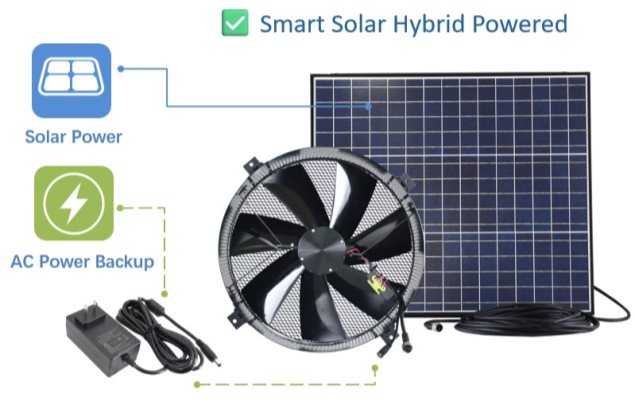
Instead of forcing you to choose between "solar-only" and "grid-tied," they built a smart controller that manages power sources automatically:
|
Time of Day |
Power Source |
What Happens |
|---|---|---|
|
Sunny daytime |
Solar panel |
Fan runs at full speed on free energy. Backup sources idle. |
|
Cloudy/overcast |
Solar + Backup |
Fan draws from solar first; supplements from battery or grid only as needed. |
|
Nighttime |
Battery or grid |
Fan keeps running seamlessly. Controller switches back to solar the moment sunlight returns. |
The result: You get continuous ventilation without thinking about it. No switches to flip. No timers to set. No "I forgot to turn it back on" moments.
Where This Actually Makes Sense (Beyond Attics)
Because the fan mounts on a vertical wall and comes with adjustable solar panel brackets, it ends up working in places most ventilation products can't touch:
· Workshops and garages — Welding fumes, paint odors, engine exhaust. Push them out without running up the shop's electric bill.
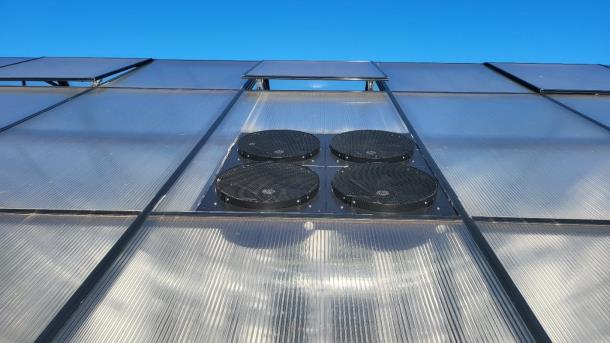
· Greenhouses — Temperature spikes kill plants. This fan activates exactly when the sun is hottest, protecting crops automatically.
· Poultry and livestock barns — Humidity and ammonia buildup are constant problems. Continuous ventilation (day and night) improves animal health and reduces mortality.
· Prefab cabins and tiny homes — Many off-grid or semi-off-grid structures lack attic space for traditional roof vents. A gable wall mount solves that.
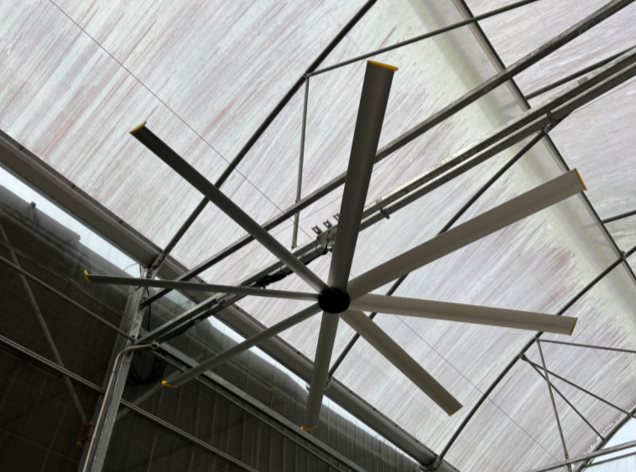
· Warehouse mezzanines — Hot air stratifies at high ceilings. A gable fan at the peak pulls it out before it radiates back down.
What About Battery Backup? (The Honest Answer)
SIPL offers two ways to get 24/7 operation:
Option 1: AC/DC Adapter
Simple. Plugs into any outlet. The fan uses solar during the day, switches to grid power at night. Electricity cost is minimal — we're talking about a fan that draws less power than a laptop.
Option 2: Solar Battery
A lithium iron phosphate battery (16V, 9.6Ah) that charges during the day and runs the fan through the night. Fully charged in about 5 hours of sun. Discharge time: 24–25 hours of continuous fan operation.
If you're truly off-grid, option 2 makes sense. If you just want to cut costs without buying batteries, option 1 gets you there with less upfront investment.
The Numbers That Matter
|
Model |
Solar Panel |
Fan Size |
Max Airflow |
Noise |
Best For |
|---|---|---|---|---|---|
|
SN2015010 |
40W |
12" |
1503 CFM |
<45 dB |
Small attics, cabins, sheds |
|
SN2015004 |
40W |
14" |
1764 CFM |
<45 dB |
Standard residential attics |
|
SN2016028 |
50W |
14" |
1879 CFM |
<45 dB |
Larger homes, workshops |
|
SN2018032 |
60W |
14" |
2003 CFM |
<45 dB |
Hot climates, commercial spaces |
One Configuration You Probably Haven't Considered
Here's something most people miss: SIPL's square mounting frame lets you combine multiple 14" fans into a single unit.
· 2-in-1 configuration for larger gable walls
· 4-in-1 (832x832mm) for industrial applications
· 6-in-1 (832x1248mm) for warehouses and agricultural buildings
Same smart controller logic applies. Same automatic solar priority. Just multiplied airflow.
One client in Texas used a 4-fan array to ventilate a 10,000 sq ft metal workshop. Zero increase in their electric bill during summer months. Their previous ventilation strategy? Four grid-tied fans running 8 hours a day, adding roughly $80/month to operating costs.
Ready to Stop Paying to Vent Your Attic?
SIPL offers factory-direct pricing, global shipping, and support for homeowners, contractors, and distributors alike.
Get a quote or ask about your specific application:
🔗 https://sunnyintlpowerltd.com
📧 sales@sunnyintlpowerltd.com
📞 +86 750-6219188

-
How Can Solar Powered Vent Fans Improve Your Home Cooling
넶16 2026-07-17 -
-

-
-
-