

Water Tank Cooling Q-A Solar Fan vs. Evaporative Cooler — Which Actually Works
Water Tank Cooling Q&A: Solar Fan vs. Evaporative Cooler — Which Actually Works?
If you manage water storage for agriculture, industry, or municipal supply, you already know the stakes: overheated tanks = spoiled water, higher treatment costs, and system strain.
Many buyers first consider traditional evaporative coolers because they seem affordable and familiar. But do they really deliver long-term value? Below, we answer the most common questions facility managers ask when comparing solar water tank cooling fans with evaporative systems—so you can choose the right solution with confidence.

Q1: How does a solar water tank fan actually cool the water?
A: Instead of adding moisture, a solar water tank fan uses forced air exchange.
It extracts superheated, humidity-saturated air from the top of the tank and draws in cooler, drier outside air through lower vents.
✅ Result: Both temperature andhumidity drop—without introducing untreated water.
By contrast, evaporative coolers blow moist air intothe tank, which can worsen humidity problems in already damp environments.
Q2: Does a solar fan still work during rainy or humid weather?
A: Yes—this is where solar fans dominate.
Traditional evaporative coolers lose efficiency when humidity rises and become nearly useless at night or during rain.
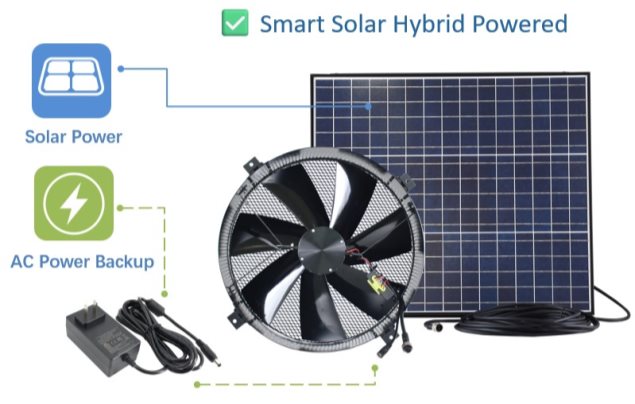
The SIPL Solar Water Tank Fan works whenever outside air is cooler than inside air.
Because it relies on temperature differential—not evaporation—it performs consistently in humid climates, rainy seasons, and at night.

Q3: Which system costs more over time: solar fan or evaporative cooler?
A: The evaporative cooler usually costs moreover 5–10 years.
|
Cost Factor |
Evaporative Cooler |
SIPL Solar Fan |
|---|---|---|
|
Upfront Price |
Lower |
Higher |
|
Electricity |
High (pump + fan) |
Zero (solar-powered) |
|
Water Usage |
Continuous |
None |
|
Maintenance |
Frequent (pads, pumps, scaling) |
Minimal |
|
Lifetime Cost |
High |
Low |
Most facilities recover the higher upfront cost of a solar fan within 1–2 years, then enjoy pure savings.
Q4: Is there a water contamination risk with evaporative coolers?
A: Yes—and it’s a serious concern.
Evaporative systems circulate stagnant water through pads, which can harbor bacteria, algae, and mold. These contaminants may enter your tank.
The SIPL Solar Fan is physically isolated from the water supply.
✅ No water contact
✅ No bacterial risk
✅ Cleaner, safer stored water

Q5: How difficult is installation?
A: Solar wins on simplicity.
· Evaporative Coolers: Require plumbing + electrical wiring + water hookups.
· Solar Water Tank Fans: Require only sunlight. No plumbing. No trenching. No grid power.
That makes solar fans ideal for rooftops, remote tanks, and off-grid sites.
Q6: Which system lasts longer with less maintenance?
A: Solar fans are far lower maintenance.
Evaporative coolers demand constant attention:
❌ Pump failures
❌ Pad replacements
❌ Mineral scaling
❌ Mold cleaning
Solar fans have no water-contact parts, fewer failure points, and operate reliably with minimal servicing.
Q7: What’s the environmental impact?
A: Huge difference.
· Evaporative coolers consume water + grid electricity continuously.
· Solar fans run on 100% renewable energy with zero operational carbon footprint.
Choosing solar supports ESG goals, sustainability reporting, and regulatory compliance.
Final Verdict: Which Cooling Solution Should You Choose?
If you want:
✅ Predictable performance
✅ Zero water use
✅ No electricity bills
✅ Safer water quality
✅ Minimal maintenance
…then the SIPL Solar Water Tank Fan is the smarter long-term investment.
While evaporative coolers may look cheaper upfront, their hidden costs—energy, water, repairs, contamination risk—quickly outweigh the savings.
Ready to Cool Your Water Tanks Smarter?
Stop overpaying for unreliable cooling. Switch to a solar-powered, maintenance-free solution that pays for itself.
[Request a Free Water Tank Cooling Consultation Today]

-
How Can Solar Powered Vent Fans Improve Your Home Cooling
넶79 2026-07-17 -
-
-
-
-